Kapellmeister or bust?

This box of German chocolates from Eloquence is definitely a surprise. One is initially inclined to defend it, if only because it was met with an indignant shriek from a prominent Internet philistine. In response to that Lady Bracknell-esque, “How dare they” high dudgeon, the reasonable listener might to give Otto Gerdes (1920-89) a fresh listen. Yes, his is not the first name in Deutsche Grammophon’s conductorial roster that one would single out for integral-set treatment. But he was at the helm for several consequential recordings and this is our likeliest—and cheapest—chance to own them.
Like other record producers before (Victor Olof and Charles O’Connell, among others) and since (Charles Gerhardt), Gerdes was a Tonmeister who aspired to the conductor’s podium. At this, he was more successful than most. Such aspirations evidently grated on the notorious insecurities of DG’s podium god, Herbert von Karajan. A tense relationship at the mixing board was irreparably broken when Gerdes (jokingly?) addressed Karajan as “colleague.” Such temerity!
Minus DG’s backing—soon withdrawn—Gerdes’ conducting career faded into obscurity and his recordings hit the deletion bin. The Eloquence compilation won’t make the case for Gerdes as an overlooked-but-major talent. However, there is some silver amidst the dross … almost enough to justify the modest asking price for the whole box. Taking the discs in order, we find …

Torelli-Trumpet Concerto in D, “Estienne Roger”; Haydn-Trumpet Concerto in E-flat; Telemann-Trumpet Concerto in D; L. Mozart-Trumpet Concerto in D (arr. Seiffert): Pierre Thibaud/Bamberg Symphony Orchestra; 1970
Kicking off the proceedings with some atypical repertory, we find four thoroughly agreeable trumpet concerti, from late in Gerdes’ recording career. Pierre Thibaud, stepping out from the Munich Bach Orchestra, makes a brilliant and persuasive soloist, given lively accompaniment from the Bambergers. Gerdes supplies up-tempo direction in readings that may not be the last word in Classical or Baroque style, but which wear their 55 years lightly.
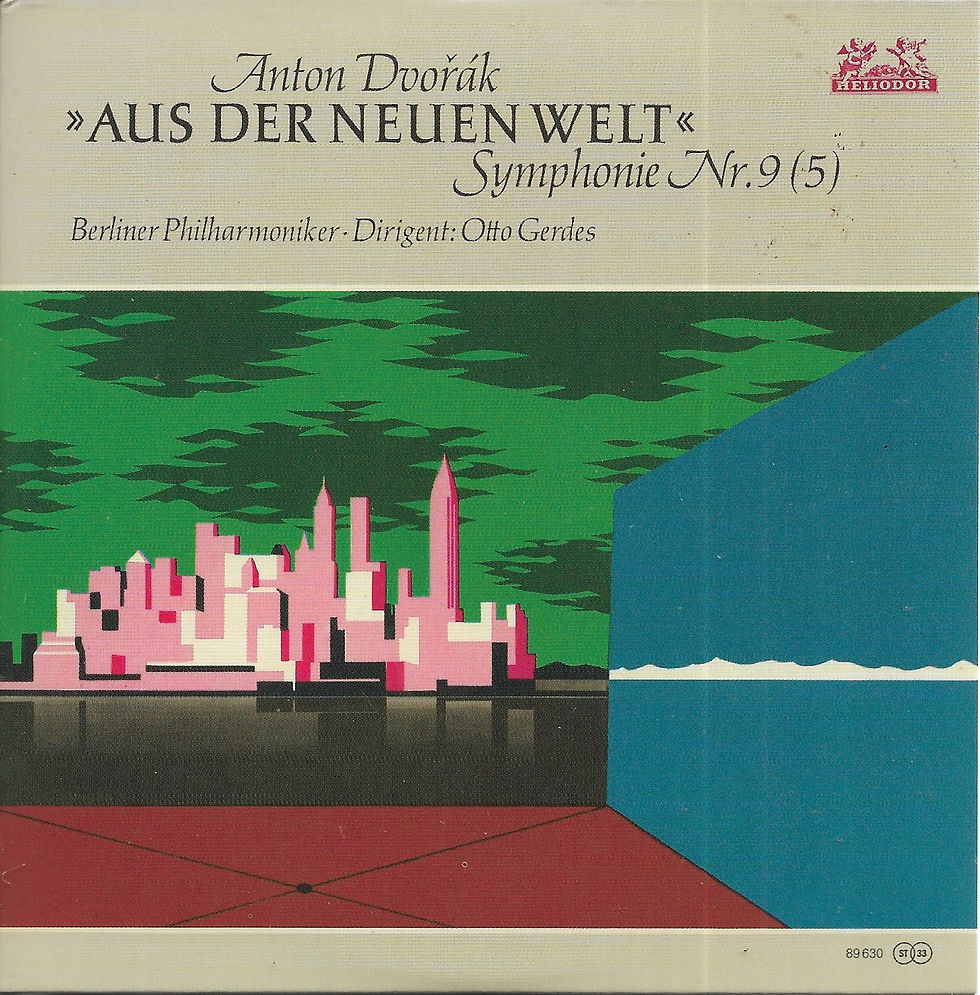
Dvorak-Symphony #9 in E minor, “From the New World”: Berlin Philharmonic; 1964
Whereas Gerdes’ Brahms (see below) would make memorable concert fare, the same cannot be said for his Dvorak “New World” symphony. It’s not badly led or played, simply a bland, pleasant, middle-of-the road reading of a piece that has been done many, many times on disc—often better. Two starkly memorable renditions are those of James Levine/Chicago Symphony (RCA) and Jascha Horenstein/Royal Philharmonic (Urania). Gerdes is superfluous.

Brahms-Symphony #4 in E minor; Wagner-Die Meistersinger Overture: Berlin Philharmonic; 1961 & 1963
Two bitter compositional antipodes share disc space. The Berlin Philharmonic does not distinguish itself in these readings, perhaps lacking respect for Gerdes as conductor. Nonetheless, the Brahms is an ardent, songfully phrased interpretation that one would enjoy in the concert hall. For immortalization on CD, it needs to be better. The Meistersinger overture illustrates the difficulty of letting Wagner’s counterpoint breathe while still honoring his prescribed 8’30” timing for the piece. Gerdes’ up-tempo reading comes closer to the latter achievement than the former.

Wagner-Symphony in C; Faust Overture; Rienzi Overture; Lohengrin: “In fernem Land”*; Weber-Der Freischütz: “Durch die Waelder”*: Cornelius van Dijk*/Bamberg Symphony Orchestra; 1971 & 1962*
The purely orchestral Wagnerian items represent Gerdes’ last hurrah in the recording studio, in April 1971. Adding insult to injury, they weren’t released in the U.S. for several more years. The Symphony is a very spirited work, Schumann-esque in its orchestral colors and style. It certainly intrigues one as to what Wagner might have further done as a symphonic composer. Clearly, he did not need the stage to fire his imagination.
The performance itself has a tentative aira, as though conductor and orchestra were feeling their way through the piece—as well may have been the case. A much fierier reading is easy to imagine. For the Symphony in C, I would probably gravitate to Jun Maerkl (Naxos), who throws in Wagner’s unfinished Symphony in E-flat for good measure. So does Neeme Jarvi (Chandos), who generously includes the Rienzi Overture (Gerdes’ version is pedestrian) and two marches.
A wobbly tuba solo gets the Gerdes-led Faust Overture off to a literally shaky start but conductor and orchestra soon the seize the piece by its throat. In two German arias, Cornelius van Dijk has some good interpretive ideas and a shining top register, but his careful utterance and heavily accented German hint at why a major career was not his.

Wolf-Italian Serenade; Penthesilea; Songs (9)*: Evelyn Lear*, Thomas Stewart*/Vienna Youth Choir*/Vienna Symphony Orchestra; 1969
Taken from a pair of concerts (and rehearsals) in Vienna, these performances show that Gerdes wasn’t a creature of the studio. The Vienna Symphony plays for him with passion, if without the last word in tonal refinement. The Italian Serenade works its usual charm and Penthesilea exudes some heady Romantic perfumes. However, it overstays its welcome, particularly in a bombastic finale that makes Scriabin’s Poem of Ecstasy sound circumspect.
Evelyn Lear, a cherishable artist, makes heavy weather of “Mignon,” which lies much too low for her. In three other songs (“Gebet,” “Neue Liebe” and “Wo find ich Trost”) she is her fervent, appealing self, giving noteworthy performances. Thomas Stewart, though, was going through a bad patch, evidently. He sounds worn and uncertain of pitch in three “Harfenspiel” songs. Surprisingly, he rallies for the stentorian declamation of “Prometheus,” a full-blown scena for Heldenbariton. The choral “Der Feurreiter” rounds off the disc in a downbeat manner.

Wagner-Die Meistersinger Overture; Schmidt-Notre Dame Intermezzo*; Verdi-La Forza del Destino Overture; Leoncavallo-Pagliacci Intermezzo; Mascagni-Cavalleria Rusticana Intermezzo; Bizet-Carmen Suite—Leipzig Radio Symphony Orchestra; 1954 & 1959*
Mozart-The Magic Flute Overture; Verdi-Aida Ballet Music; Weber-Der Freischütz Overture—Berlin Radio Symphony Orchestra, 1959
Gerdes’ earliest sessions here receive their first release. They need not have. The Meistersinger overture sets an unpleasant tone for what follows—gritty-sounding and not well played. The surefire Notre Dame intermezzo similarly sets one’s teeth on edge. Ironically, Karajan remains sovereign in that piece. The Italian repertory is efficiently conducted by Gerdes but without any sign of feeling for the idioms involved. At least the Carmen morceaux engage him. The selections with the Berlin Radio Symphony are comparably faceless but the orchestral playing is preferable to that of the Leipzig sessions.
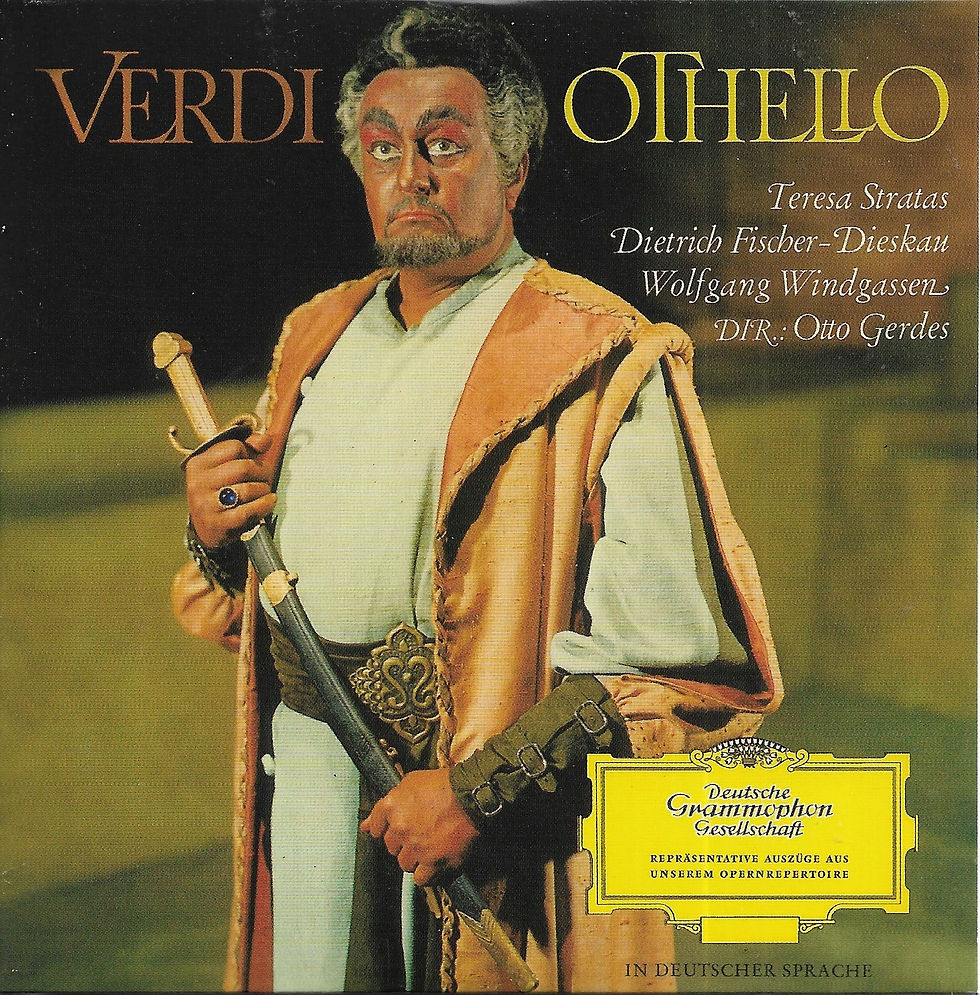
Verdi-Otello (exc.): Teresa Stratas, Wolfgang Windgassen, Dietrich Fischer-Dieskau/Bavarian State Opera Chorus & Orchestra, 1967
Many fine Verdi recordings have been sung in Goethesprach. One thinks of Helge Roswaenge’s “Niun mi tema” (er, “Jeder Knabe”) from this very opera. This particular Großer Querschnitt (62 minutes) doesn’t quite make the case for Verdi in German, but not for linguistic reasons. Gerdes’ conducting is vivid and mostly idiomatic, and the chorus is a splendid group. However, many years of heavy Wagnerian labor had taken their toll on Wolfgang Windgassen’s voice. To be sure, he presents a personaggio and is a sensitive duet partner.
“Esultate!” (let’s stick to Italian for convenience) manifests that this is an aged Otello, one who is making heavy weather of the music. It could be a viable interpretation: the Moor as an older, vulnerable man in love. But Windgassen’s tone is parched and worn, and every flip into his upper register is an adventure. His Iago outsings him in “Si, pel ciel,” while both “Dio, mi potevi” and the finale have an unwelcome overlay of lachrymosity.
Against him, Dietrich Fischer-Dieskau is an impeccably sung Iago. The Credo is far too red of tooth and claw but “Era la notte” is vocal gossamer and there’s hardly a FiDi mannerism in sight. Even so, he would make an even better stab at the role in Italian for Sir John Barbirolli (EMI). The great performance here is Teresa Stratas’ Desdemona. Her distinctive, resinous tone is lovingly conducted through Verdi’s long phrases and delectably placed in the mask. Aside from a gurgly dip into chest voice in the love duet and some unwelcome aspirates in the Ave Maria, it’s extremely difficult to fault such aristocratic musicianship, tinged with hints of sensuality, along with plentiful sweetness and vulnerability. This disc is also available separately.

Tchaikovsky-Eugene Onegin (exc.): Evelyn Lear, Brigitte Fassbaender, Fritz Wunderlich, Dietrich Fischer-Dieskau, Martti Talvela/Bavarian State Opera Chorus & Orchestra, 1966
This is the jewel of the set: 67 minutes of scenes from Tchaikovsky’s pastoral drama. Gerdes’ participation was almost accidental. He substituted for an unnamed colleague and distinguished himself. At first blush, the reading may seem almost blank but, upon repeated listenings, Gerdes’ restraint proves winning and he’s capable of whipping up a Slavic storm when the situation requires it. Once past an infelicitous Act I quartet—with everyone singing much too loudly—the performance is a joy.
OK, Dietrich Fischer-Dieskau is at his huffiest for the first two acts, presenting a self-regarding and fairly repellent Onegin. It’s clearly an interpretive choice and Fischer-Dieskau is considerably more straightforward as the chastened Onegin of the finale (if still a little too declamatory). However, nothing but honey flows from the throat of Fritz Wunderlich as Lensky. All Wunderlich recordings are worth hearing and this one is especially good, filled with ardor and melancholy, as befits the role, and perfectly sung.
The linchpin of any good Eugene Onegin is Tatiana and Evelyn Lear shows why she is such a treasure, her bittersweet, vibrant tone flowing freely and brimming with expression. The role suits her instrument particularly well, never more so than in the Letter Scene, as she girlishly muses whether Onegin is a savior or tempter. Brigitte Fassbaender gets little chance to show her stuff but Martti Talvela gives a dignified and loving account of Prince Gremin’s aria, the national anthem of bassos everywhere.
Yes, both this and Otello are sung in German. Far better to hear singers in a language they know and can express keenly here than enunciating transliterated Russian.

Wagner-Tannhauser: Birgit Nilsson; Wolfgang Windgassen, Dietrich Fischer-Dieskau, Theo Adam/Deutsche Oper Chorus & Orchestra, 1968-9
Many of us discovered Gerdes through his lone complete-opera recording, made over three sets of sessions in Berlin. It hasn’t worn its years well. In fact, it’s the final nail in the coffin of Gerdes’ reputation. The overture is nothing short of disastrous: The Pilgrims’ Chorus theme is drab, lifeless and the Venusberg music lacks excitement. As it plods to the double-bar, the Deutsche Oper band just churns out meaningless scrums of notes.
Once the singing begins, Gerdes unaccountably springs to life, albeit of a generalized ‘energetic’ sort. At least he keeps things moving, which is a wonderful idea under the circumstances. While the conductor seems more engaged, the bursts of orchestral vigor often seem unrelated to what’s transpiring. There are passing felicities of tone painting, but too many lapses such as the inane scramble that is “Gepriesen sei die Stunde” or the muted, divertissement treatment of the entry of the nobles. “O du, mein holder Abendstern” is sensitively accompanied but Elisabeth’s despairing exit is callously phrased and the chorus of returning Pilgrims evokes a beer hall.
While it is impressive in a strange way how much of Tannhauser still manages to occur, Gerdes’ leadership renders it inconsequential. He gets trim execution from his Berlin forces but one is left longing for the untidier—but more pertinent—contributions of Franz Konwitschny’s East Berlin ensemble (EMI Electrola).

Wolfgang Windgassen handles the punishing title role surprisingly well for someone pushing age 60. That being said, this is Tannhauser as senior citizen. Windgassen has to simplify Wagner’s passagework and his tone has taken on an incipient whine that frequently shades into outright self-pity. The tenor redeems himself somewhat with a Rome Narrative that’s more deeply introspective than his consonant-spitting Bayreuth renditions, ending more honorably than he began.
Both the women in Tannhauser’s life are embodied by Birgit Nilsson, although sensuality is not hers to command, which shortchanges Venus. She softens her timbre for the temptress but is surprisingly cautious negotiating the notes. Elisabeth, on the other hand, is a success, every note beautifully sounded as Nilsson persuasively assumes the vocal guise of a blushing maiden. She carries Act II, although this Elisabeth doesn’t touch the heart quite as some (arguably lesser) artists have done.
“All’maechtge Jungfrau!” is affecting, even if when Wagner calls for mezza-voce, Nilsson has already chastened her generous sound so much there’s nowhere left to attenuate. Only pealing top notes hint that this Elisabeth is a Valkyrie in disguise.

Dietrich Fischer-Dieskau must compete with his younger self (on Electrola) and does so convincingly. This is a more cantabile, Italianate rendition of Wolfram. The baritone sounds hardly a day older, less hortatory, with faultless legato and the same easy access to head voice, so essential to projecting Wolfram’s ethereal character.
Although Theo Adam tries to humanize the Landgrave, his dry, baritonal voice gives scant pleasure. Both Walther von der Vogelweide and Biterolf are too lightly cast, Hans Sotin’s powerful bass is wasted on a bit part, and the precariously sung Shepherd scuttles that pastoral episode, so atmospherically rendered in the Konwitschny recording and others.
Even if you want Tannhauser in the Dresden edition, to which Gerdes adheres, you can do better not only with Konwitschny but also Bernard Haitink’s digital set (EMI). Neither conductor has an appealing protagonist—Hans Hopf for Konwitschny and Klaus Koenig for Haitink—so you have to hold your nose and take your chances.

But the earlier set has a near-incomparable Elisabeth in the vibrant, communicative Elisabeth Grümmer and Haitink’s Lucia Popp is nearly as impressive. Kurt Moll (Haitink) may be preferable to the older Gottlob Frick (Konwitschny), and the newer set also has Bernd Weikl as Wolfram and Waltraud Meier as Venus, not-inconsiderable interpreters. Konwitschny, meanwhile, benefits from a tremendously theatrical audio production, including the charming interpolation of cowbells behind the Shepherd’s Act I song (equally beguilingly sung by Lisa Otto).
Konwitschny vs. Haitink is going to be a difficult choice and I don’t envy you. For the more lavish Paris version, Sir Georg Solti’s recording (Decca) remains in possession of the field, even if Helga Dernesch (as Elisabeth) is where Leonie Rysanek ought to have been. Then there are Dresden/Paris hybrids and live-performance recordings, if you truly want to set the cat amongst the pigeons …
Except for Gerdes fanatics, there can’t be much of an audience left over for this Tannhauser. Fischer-Dieskau fans can obtain it as a DG Trio stand-alone set, while Nilsson completists will already have it in the indispensable “La Nilsson” box set (Decca OOP).
As for Gerdes himself, he might have had a decent career as a Kapellmeister at a second- or third-tier German opera house. But a major conductor? Not a chance. No sale, Eloquence.


Comments